


Conferência Final do projeto FIREUSES | Closing conference of the FIREUSES project | apr 2025
- Título | Title
- Conferência Final do projeto FIREUSES | Closing conference of the FIREUSES project | apr 2025
- Data | Date
- 24/04/2025
- Notícia | News
-
No dia 24 de abril, na véspera do 51º aniversário do 25 de Abril, teve lugar a conferência de encerramento do projeto FIREUSES, que decorreu no auditório da Biblioteca Nacional de Portugal. Durante pouco mais de três anos, a equipa do projeto submeteu o atual regime de grandes incêndios em Portugal a uma investigação histórica sobre a sua origem e desenvolvimento ao longo do século XX. Sem deixar de parte a incidência crescente dos incêndios rurais nas últimas quatro décadas, amplamente estudada pelas ciências ecológicas e florestais, a equipa do projeto analisou maioritariamente o período do Estado Novo, mapeando, por um lado, a emergência do problema dos incêndios nos discursos político e científico e, por outro lado, a transição rural entre as agriculturas do fogo e o incêndio florestal no período 1950–1980. Estas duas paisagens de fogo, fundamentalmente distintas, foram analisadas em dois espaços de montanha, o planalto serrano entre a Lapa e Nave, no norte do país, e a serra de Monchique, a sul.
Cedo se percebeu, porém, que a política e a ciência do fogo do Estado Novo assentaram em bases intelectuais e legislativas anteriores, tais como o Regime Florestal, aprovado em 1901–1905, e a afirmação da silvicultura no final do século XIX. Desde então, as serras portuguesas passaram a ser imaginadas como paisagens sem fogo. A exclusão das práticas de fogo foi apoiada por um consenso científico crescente que condenava o cultivo de cereais através do fogo como “primitivos” e fonte de desequilíbrio ambiental. O fogo passou a ser visto como “inimigo” da floresta no âmbito de uma oposição ecológica entre a árvore e o fogo e de um projeto amplo de modernização dos sertões serranos por via da arborização.
No entanto, parece claro que estas tentativas de restrição do fogo falharam. Os incêndios rurais tornaram-se, a partir dos anos 1960, cada vez mais comuns e destrutivos, devastando um território a cada ano mais inflamável. Nos meses de verão, outrora dedicados às roças e queimas extensivas, os avisos insistentes sobre o risco de incêndio dominam as emissões de rádio e televisão. Numa irónica volta do destino, a recuperação das “perniciosas tradições” do fogo, como o fogo controlado e o contra-fogo, são agora apresentadas pelos especialistas como uma saída para este enigma ardente.
Na conferência, apresentaram-se os principais resultados alcançados, através das seis comunicações que compuseram o painel da manhã e que foram comentadas pela arquiteta e historiadora Marta Macedo. Durante a tarde foram apresentadas outras perspectivas e geografias do fogo, onde se procurou esboçar um quadro global multidisciplinar, comentado no final pelo historiador e antropólogo Ricardo Roque. Contámos com as histórias do fogo nas montanhas vizinhas da Galiza (Lourenzo Prieto e David Fontán) e de Kroumirie, atravessadas pela divisória colonial que separa a Tunísia da Argélia (Myriam Amri), os primeiros resultados de uma investigação sobre a “ressurgência” de paisagens danificadas pelo fogo entre Arganil, Portugal, e o Cerrado brasileiro (Kátia Favilla e Susana Matos Viegas) e, a encerrar o painel, uma reflexão informada e desafiante sobre o “paradoxo do fogo” em Portugal (Paulo M. Fernandes).
A conferência de abertura esteve a cargo de Francisco Moreira, investigador de longa data em ecologia e comportamento do fogo e também consultor do projeto, que abordou a necessidade de mudar o paradigma da gestão de incêndios. A conferência foi encerrada com uma palestra pelo historiador ambiental Simon Pooley, em que procurou cruzar a história ecológica e científica do fogo na África do Sul, que estuda há várias décadas, com as cronologias e principais conclusões do FIREUSES sobre Portugal.
On 24 April, on the eve of the 51st anniversary of the 25 April 1974 revolution, the closing conference of the FIREUSES project took place in the National Library of Portugal. Over the last three years, the project team has subjected Portugal's current major fire regime to a historical investigation into its origins and evolution throughout the 20th century. Not forgetting the increasing incidence of rural fires over the last four decades, which has been widely studied by ecological and forestry sciences, the project looked mainly at the Estado Novo period, mapping on the one hand the emergence of the “fire problem” in political and scientific discourse, and on the other the transition between fire agriculture and forest fire in the period 1950–1980. These two fundamentally different burning landscapes were analysed in two mountain areas, the Lapa and Nave plateau to the north and the Monchique mountain range to the south.
It soon became clear, however, that the Estado Novo's fire policies were based on previous intellectual and legislative foundations, such as the Forestry Regime approved in 1901–1905 and the consolidation of scientific forestry in the late 19th century. Since then, the Portuguese mountains have been imagined as fire-free landscapes. The exclusion of fire practices was supported by a growing scientific consensus that condemned the cultivation of cereals through fire as “primitive” and a source of environmental imbalance. Fire came to be seen as an “enemy” of the forest in the context of an ecological opposition between trees and fire and a broad project to modernise the highlands through afforestation.
However, it seems clear that these attempts to limit fire have failed. From the 1960s onwards, rural wildfires became increasingly common and destructive. In the summer months, once devoted to extensive slash-and-burn cultivation, insistent warnings about the risk of fire dominate radio and television broadcasts. In an ironic twist of fate, the recovery of the “pernicious traditions” of fire use are now presented by experts as a way out of this burning conundrum.
The conference showcased the main results achieved through six papers that made up the morning panel and were commented on by architect and historian Marta Macedo. In the afternoon, other perspectives and geographies of fire were presented in an attempt to sketch out a global multidisciplinary picture, which were finally discussed by historian and anthropologist Ricardo Roque. We listen to the histories of fire in the neighbouring mountains of Galicia, Spain (Lourenzo Prieto and David Fontán), and Kroumirie, crossed by the colonial partition separating Tunisia from Algeria (Myriam Amri), the first results of a study on the “resurgence” of fire-damaged landscapes between Arganil in Portugal and the Brazilian Cerrado (Kátia Favilla and Susana Matos Viegas) and, to conclude the panel, an informed and challenging reflection on the “paradox of fire” in Portugal (Paulo M. Fernandes).
The opening lecture was given by Francisco Moreira, a researcher in ecology and fire behaviour, and also a consultant to the project, who addressed the need to change the paradigm of fire management. The day concluded with a talk by environmental historian Simon Pooley, in which he sought to cross-reference the ecological and scientific history of fire in South Africa, who proposed a cross-reference between the ecological and scientific history of fire in South Africa, which he has been studying for several decades, with the chronologies and main conclusions of FIREUSES on Portugal.
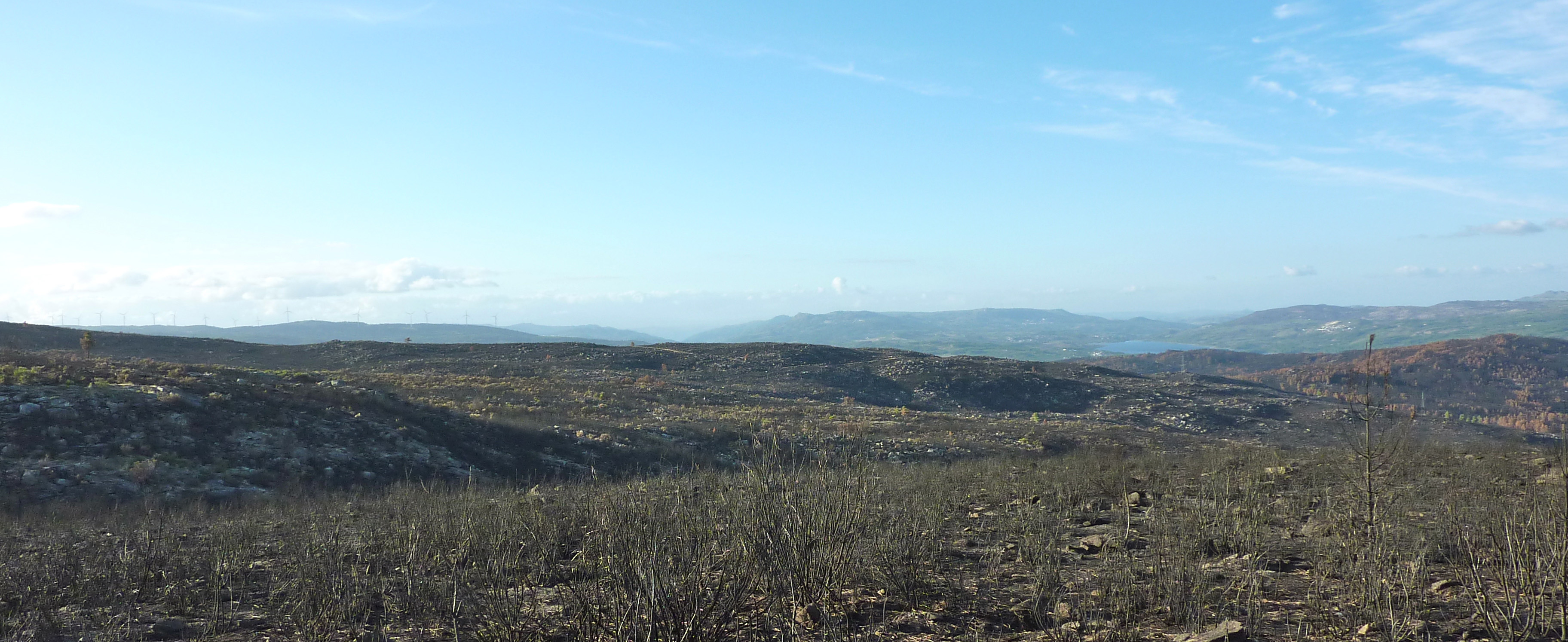
Serra da Lapa, 6 de agosto de 2020